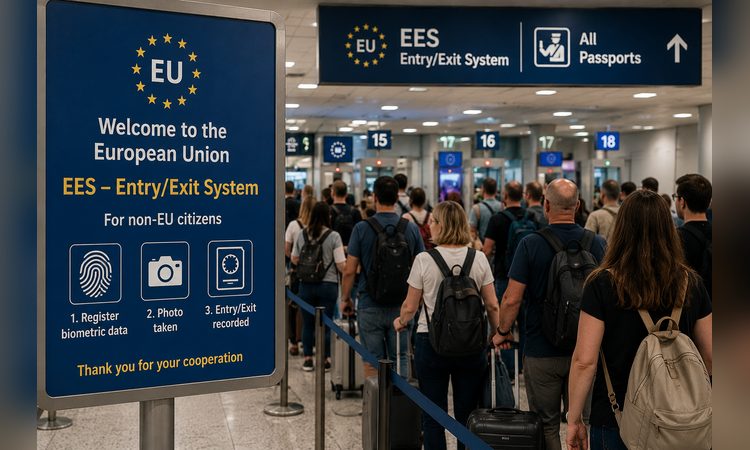
Europe’s EES Safety Valve Ends Monday as Missed Flight Connections Double
Travel expert warns British holidaymakers not to assume arriving early will protect them from disruption as temporary flexibility over biometric border checks comes to an end British travellers heading to Europe from next week could face a tougher test of the EU’s Entry/Exit System, as temporary measures designed to relieve severe queues are expected to come to an end on Monday, 7 September.
The change comes amid fresh reports that missed flight connections have doubled since the new border system was introduced, with some airlines reportedly experiencing an even greater increase in affected passengers.
The Entry/Exit System, known as EES, records passport information, facial images and fingerprints from most non-EU travellers entering the Schengen Area for short stays.
The system became fully operational across participating European borders on 10 April 2026, following a progressive rollout that began in October 2025.
However, European authorities have had an important safety valve available during the transition.
Under EU rules, countries have been permitted in exceptional circumstances to temporarily suspend the collection of biometric information at individual border crossings when passenger volumes become so high that waiting times become excessive.
That flexibility was designed to prevent already congested passport-control areas from becoming overwhelmed.
From 7 September, that temporary period is expected to expire, meaning airports and border authorities will have less flexibility to ease biometric requirements simply because queues have become excessive.
‘The real concern is what happens when there is nowhere for the queue to go’
Jurgen Himmelmann, co-founder and CEO of Global Work & Travel, says travellers should build significantly more time into journeys involving European border controls over the coming weeks.
Jurgen Himmelmann, co-founder and CEO of Global Work & Travel said:
“The important thing for travellers to understand is that EES delays don’t necessarily happen at the airline check-in desk. They can happen at passport control, where passengers have far less control over how quickly they move through the airport.
Until now, authorities have had additional flexibility to ease biometric checks when queues became excessive. If that flexibility disappears, the real concern is what happens when there is nowhere for the queue to go.
We’ve already seen reports of missed connections increasing under EES, so this isn’t simply a theoretical problem ahead of Monday.
For British travellers, I’d be particularly cautious about tight connections, airports where passport control comes late in the journey and return flights where you need to clear an external Schengen border before reaching the gate.”
Could arriving at the airport earlier actually help?
Himmelmann says passengers should leave considerably more time than they previously would have done, but warns that simply arriving several hours early does not eliminate the risk.
He explained:
“Getting to the airport early is sensible, but there is a limit to how much control that gives you.
Bag-drop desks may not be open four hours before departure, and once you’re in a passport-control queue, you can’t simply skip ahead because your flight is boarding.
I’d avoid planning a journey around the minimum connection time over the next few weeks. A connection that looks perfectly reasonable on paper can become uncomfortable very quickly if you lose an hour or more at the border.”
What happens if an EES queue makes you miss your flight?
Travellers should not automatically assume an airline will compensate them if they miss a flight because they were delayed at passport control.
Border-control queues are generally outside an airline’s control, meaning the protections passengers associate with airline-caused cancellations and delays may not apply in the same way.
Jurgen Himmelmann, co-founder and CEO of Global Work & Travel said:
“This is probably the biggest practical issue British travellers need to understand.
If an airline delays your flight, there are established passenger rights. If your aircraft leaves on time but you’re stuck at passport control, the situation can be very different.
Check your travel insurance before leaving, particularly the wording around missed departures and missed connections. Don’t assume that having insurance automatically means an EES-related delay will be covered.”
Five things Brits travelling to Europe should do from 7 September
1. Allow significantly more time at airports involving Schengen border controls
Normal airport timings may not account for an unexpectedly long EES queue.
2. Be cautious with short connections
Where possible, choose itineraries with more breathing room between flights, particularly when changing between Schengen and non-Schengen services.
3. Check where passport control happens
Understanding whether you’ll clear immigration on arrival, during a connection or before departure can help identify where delays could affect the journey.
4. Check missed-departure cover before travelling
Read the actual policy wording rather than assuming passport-control delays are included.
5. Keep an eye on your airport and airline before travelling
Conditions can vary significantly between airports and even between different times of day.
Jurgen Himmelmann, co-founder and CEO of Global Work & Travel added:
“I wouldn’t tell people to avoid travelling to Europe because of EES. Millions of journeys will continue normally.
But the system is still relatively new, and we’re moving into another important stage of its implementation. The sensible approach is to give yourself more margin than you think you’ll need, particularly if missing one flight would unravel the rest of your trip.”
Notes
About EES
The European Union’s Entry/Exit System is an automated border-management system used to register non-EU nationals travelling to participating European countries for short stays of up to 90 days within a 180-day period.
The system records information including travel-document details, biometric data and entry and exit information.
EES became fully operational at participating external border crossing points on 10 April 2026 following its progressive introduction from October 2025.
EU Regulation 2025/1534 provided a temporary mechanism allowing Member States, in exceptional circumstances where traffic resulted in excessive waiting times, to partially suspend
EES biometric registration at individual border crossing points.
About Global Work & Travel
Global Work & Travel helps travellers plan and book working holidays, volunteering trips, teaching programmes, internships and other structured travel experiences around the world.
kaynak: Cision










 Türkçe
 العربية
 English
 Deutsch
 Ελληνικά
 עִבְרִית
 Русский
 Українська